See how this has affected you · The water rate increase · Download as PDF
The "9.9%" electric rate increase: what residents were told and what they are paying
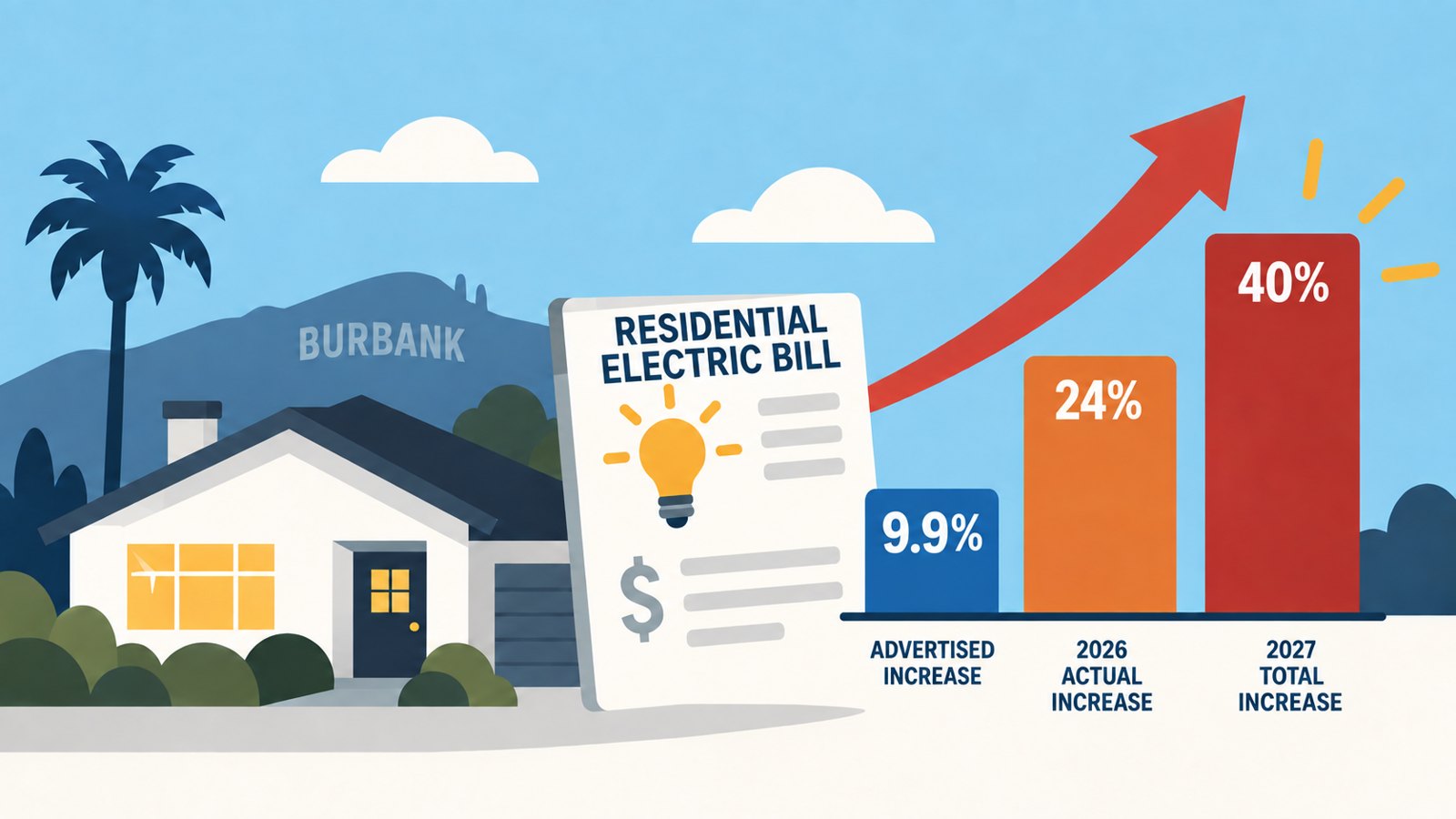
In January 2026 Burbank Water and Power raised residential electric rates, and will raise them again in January 2027. Customers were told each increase was "9.9%." That figure is an average across all of BWP's customers, including large businesses that received increases of about 6%. The figure BWP gave the City Council for homes was 14.9%, and even that number was never sent to customers.
Neither number is what homes are paying. BWP calculated the increase against a "before" rate it was not charging: it used a fuel-cost charge (the ECAC) of 13.69 cents per kWh, while every 2025 bill carried 11.78 cents. Starting from the higher number makes the increase look smaller. Measured against the bills people were actually paying, the January 2026 increase was about 24% for a typical home, and after the January 2027 step the same home's bill will be about 40% higher than it was in 2025.
A reconciliation of BWP's public statements, the rate adopted by City Council, and the bills of an actual Burbank single-family account, referred to below as the Example Account. The Example Account's 2025 bills are what make the billed-versus-published comparison possible. Every figure comes from a BWP or City of Burbank document or from those bills, and is reproducible from the adopted rate tables.
Summary
Beginning January 1, 2026, BWP's residential electric bills rose about 24% for the same usage. BWP described the change to customers as a "9.9% average rate increase" and gave one dollar example, "+$19.80/month" for a 520 kWh home. Three things account for the gap:
1. "Average" means the whole system, not the average home. The adopted resolution shows residential and small commercial customers receiving 14.9% while large commercial classes receive 6.0% to 6.5%. The 9.9% is the blend.[7]
2. The "before" bill was not the bill customers were paying. BWP's baseline uses the fee-schedule ECAC of $0.1369 per kWh. Throughout 2025 the ECAC actually billed was $0.1178. Against real bills, BWP's own 520 kWh example rises $31.12, not $19.81.[3][5]
3. The residential percentage was never printed for customers. It appears on one slide from the March 25, 2025 study session and in Exhibit B of the adopted resolution. It is absent from the mailer, the website, the general manager's op-ed, and the May 20 public-hearing presentation, which dropped the by-class slide.[1][4][6][8]
1. What customers were told
"To ensure the continued delivery of reliable electric and water services to the Burbank community by investing in infrastructure and promoting long-term sustainability, beginning January 1, 2026, BWP is proposing an electric system average rate increase of 9.9% and a water system average rate increase of 14%. An identical increase is proposed for the following year to take effect on January 1, 2027."
Notice mailed to customers, April 2025, signed by the BWP General Manager.[4] The notice contains a residential water bill-impact table at four usage levels. It contains no electric bill table and no electric dollar figure.
"Electric Average Rate Increase* 9.9%"
BWP website, "Approved Rate Increases."[1] The $19.80 figure sits directly under "9.9% Increase." On BWP's own baseline of $138.99 it is a 14.3% increase.
"*This is a system-wide average rate increase across residential and commercial accounts; the percentage (%) is different for each specific rate class."
"What Does This Mean for Your Bill? Electric Bill - Approved Rate Impact. Typical Residential Home (520 kWh/month). 9.9% Increase*. $+19.80/month"
"Average single-family residential bill increases for water and electric service will generally be higher than the system average increases."
BWP website, "Bill Calculator."[2] This is the only customer-facing statement found that says residential increases exceed 9.9%. No number is given.
"Next year, beginning January 1, 2026, BWP is proposing an electric system average rate increase of 9.9%, and a water system average rate increase of 14%."
Op-ed by the BWP General Manager, myBurbank, April 29, 2025.[8] No residential figure.
2. What the council adopted
Resolution 25-29,610, adopted May 20, 2025, includes a table of the increase by customer class in Exhibit B, page 11. The same table appeared on slide 7 of the March 25, 2025 council study session and was not included in the May 20 public-hearing presentation.[6][7]
| Customer class | Increase Jan 1, 2026 | Increase Jan 1, 2027 |
|---|---|---|
| Residential | 14.9% | 14.8% |
| Small General Service (small commercial) | 14.9% | 14.9% |
| Medium General Service | 7.0% | 6.7% |
| Large General Service | 6.3% | 6.0% |
| Extra Large General Service | 6.5% | 6.2% |
| Street Lighting | 14.9% | 14.9% |
| Overall System Average | 9.9% | 9.9% |
Source: Resolution 25-29,610, Exhibit B, p. 11, "Electric Rate Adjustments by Customer Class." The same exhibit lists the residential average rate as $0.2408/kWh current, $0.2765 in 2026 and $0.3176 in 2027.
The May 20 staff report describes the number this way: "These percentages represent the average system-wide increase across all customer classes and rate components for each customer type... However, the increases vary by customer class based on rate adjustments from BWP's COS study." It also states: "For the typical residential customer, the proposed fees and charges reflect a monthly electric bill increase of approximately $19.81."[5]
3. The baseline: the ECAC that was published versus the ECAC that was billed
The 2026 rate is a restructure, not a uniform increase. About three quarters of the Energy Cost Adjustment Charge (ECAC) was folded into the tier energy rates. In every BWP table the "current" ECAC is shown as $0.1369 per kWh. On the Example Account's twelve 2025 bills, and its January 2026 bill, the ECAC line was billed at $0.1178 per kWh every month. No public document explains the restructure or notes that the baseline differs from what was being billed.[3][7]
| Residential rate component | 2025 fee schedule | 2025 as billed | 2026 | 2027 |
|---|---|---|---|---|
| Customer service charge, per month | $14.25 | $14.25 | $19.50 | $25.00 |
| Service size charge, medium (single-family), per month | $3.96 | $3.96 | $4.45 | $5.20 |
| Tier 1 energy, first 300 kWh | $0.0294 | $0.0294 | $0.1460 | $0.1744 |
| Tier 2 energy, all additional kWh | $0.1071 | $0.1071 | $0.2442 | $0.2718 |
| ECAC, all kWh | $0.1369 | $0.1178 | $0.0340 | $0.0340 |
| Tier 2 energy + ECAC, per kWh | $0.2440 | $0.2249 | $0.2782 | $0.3058 |
| Change in Tier 2 + ECAC from 2025 | +14.0% | +23.7% | ||
| Change in fixed charges from 2025 | +31.5% | +31.5% |
Utility Users Tax (7%) and In-Lieu Transfer (7%) apply on top of these amounts and scale with them, so they do not change the percentages. BWP's own rate summary shows a "Composite (Energy Charge + ECAC)" row with percent changes for every commercial schedule; the residential page has no change columns and no composite row.[3]
4. BWP's own example homes, recalculated against real bills
The council presentations show three example homes. The 2026 and 2027 bills below reproduce BWP's slide figures to the cent using the adopted rates, which confirms the method. The only difference is the 2025 column: BWP's uses the fee-schedule ECAC, the "as billed" column uses the ECAC customers actually paid.[6]
| BWP example | 2025 bill, BWP baseline | 2025 bill, as billed | 2026 bill | Increase, BWP | Increase, actual |
|---|---|---|---|---|---|
| Apartment/condo, 345 kWh | $87.95 | $80.43 | $100.65 | +$12.70 (14.4%) | +$20.21 (25.1%) |
| "Average across all residential," 520 kWh | $138.99 | $127.67 | $158.79 | +$19.81 (14.3%) | +$31.12 (24.4%) |
| Single-family home, 744 kWh | $201.36 | $185.15 | $229.90 | +$28.54 (14.2%) | +$44.75 (24.2%) |
Bills include tier energy, ECAC, customer and service-size charges, the state energy surcharge and both 7% taxes. The apartment example uses the small service-size charge, as BWP's figures require. The Example Account, a single-family home averaging about 840 kWh per month, paid $2,508 for electricity on its twelve 2025 bills; the same usage at 2026 rates costs $3,112, an increase of $605 or 24.1%.
5. The 2027 step
The public description of the second increase is "an identical increase," again 9.9%. The adopted residential figure is 14.8%. Applied to BWP's own example homes, the 2027 bills rise 17.8% (345 kWh), 15.0% (520 kWh) and 13.4% (744 kWh) over 2026, because the customer service charge rises another 28%, from $19.50 to $25.00. Over the two steps, from what was billed in 2025 to the 2027 rate, the 520 kWh home's bill rises 43%.[6][7]
6. The Example Account's twelve 2025 bills, priced three ways
The actual 2025 electric charges for the Example Account, then the same monthly usage priced at the 2026 rate and at the 2027 rate. Each bill includes tier energy, ECAC, the customer and service-size charges, the state energy surcharge and both 7% taxes. These are the two steps BWP described as 9.9% each.[9][10]
| Bill | kWh | Paid, 2025 rate | At 2026 rate | At 2027 rate | 2025 → 2026 | % | 2026 → 2027 | % | 2025 → 2027 | % |
|---|---|---|---|---|---|---|---|---|---|---|
| Jan 2025 | 955 | $239.33 | $296.88 | $334.33 | +$57.55 | 24.0% | +$37.45 | 12.6% | +$95.00 | 39.7% |
| Feb 2025 | 782 | $194.90 | $241.95 | $273.97 | +$47.05 | 24.1% | +$32.02 | 13.2% | +$79.07 | 40.6% |
| Mar 2025 | 672 | $166.67 | $207.04 | $235.58 | +$40.37 | 24.2% | +$28.54 | 13.8% | +$68.91 | 41.3% |
| Apr 2025 | 757 | $188.49 | $234.04 | $265.24 | +$45.55 | 24.2% | +$31.20 | 13.3% | +$76.75 | 40.7% |
| May 2025 | 705 | $175.15 | $217.51 | $247.10 | +$42.36 | 24.2% | +$29.59 | 13.6% | +$71.95 | 41.1% |
| Jun 2025 | 793 | $197.75 | $245.46 | $277.80 | +$47.71 | 24.1% | +$32.34 | 13.2% | +$80.05 | 40.5% |
| Jul 2025 | 905 | $226.49 | $281.01 | $316.88 | +$54.52 | 24.1% | +$35.87 | 12.8% | +$90.39 | 39.9% |
| Aug 2025 | 969 | $242.92 | $301.32 | $339.21 | +$58.40 | 24.0% | +$37.89 | 12.6% | +$96.29 | 39.6% |
| Sep 2025 | 1,100 | $276.54 | $342.92 | $384.93 | +$66.38 | 24.0% | +$42.01 | 12.3% | +$108.39 | 39.2% |
| Oct 2025 | 825 | $205.96 | $255.62 | $288.98 | +$49.66 | 24.1% | +$33.36 | 13.1% | +$83.02 | 40.3% |
| Nov 2025 | 756 | $188.25 | $233.72 | $264.89 | +$45.47 | 24.2% | +$31.17 | 13.3% | +$76.64 | 40.7% |
| Dec 2025 | 823 | $205.44 | $254.98 | $288.28 | +$49.54 | 24.1% | +$33.30 | 13.1% | +$82.84 | 40.3% |
| Twelve 2025 bills | 10,042 | $2,507.89 | $3,112.45 | $3,517.19 | +$604.56 | 24.1% | +$404.74 | 13.0% | +$1,009.30 | 40.2% |
The 2027 column uses the adopted 2027 tier rates and $30.20 in fixed charges, with ECAC and taxes unchanged from 2026. The second step lands harder on low-usage months because the fixed charges rise $6.25 per bill regardless of usage.
What the record supports
Nothing BWP published is false. The 9.9% is a real system average, the website footnote says class percentages differ, and the 14.9% residential figure is in the adopted resolution. But every piece written for customers led with the number that applied least to residents, paired it with a dollar figure computed on a baseline higher than any 2025 bill, and never stated the residential percentage. The by-class slide shown to council in March was left out of the May public hearing. A resident who read everything BWP mailed or posted would reasonably have expected an increase of roughly 10% and received one of roughly 24%, with 40% in view once the second step lands.
Sources
- BWP, "Approved Rate Increases" (undated; footnote references May 20, 2025). burbankwaterandpower.com/approved-rate-increases
- BWP, "Bill Calculator." burbankwaterandpower.com/bill-calculator
- BWP, "BWP Electricity Rates by Customer Class, Calendar Years 2026 and 2027" (PDF, April 2025). burbankwaterandpower.com/documents/d/guest/Summary-of-Electric-Rates-by-Customer-Type_Commercial_all
- Notice of Public Hearing and customer letter mailed April 4, 2025 (Attachment 2 to the May 20, 2025 staff report). burbank.granicus.com, meta_id 444418
- City Council staff report, public hearing on utility rates, May 20, 2025. burbank.granicus.com, meta_id 444416
- Council presentations: March 25, 2025 study session (slide 7, "Rate Adjustment by Customer Class"; slide 8, "Average Residential Electric Bill Impacts") meta_id 442602; May 20, 2025 public hearing (slide 8, same bill impacts; no by-class slide) meta_id 444478
- Resolution 25-29,610, adopted May 20, 2025, Exhibit B "Electric Rate Adjustments by Customer Class," p. 11. burbank.granicus.com, meta_id 444495
- M. Samra, "Op-Ed: BWP Customers Ask, Why Are Water and Electric Rates Increasing?", myBurbank, April 29, 2025. myburbank.com
- City of Burbank, FY 2026-27 Adopted Citywide Fee Schedule, Article X (electric rates in effect). burbankwaterandpower.com/documents/d/guest/burbank_adopted_fee_schedule
- The Example Account's BWP bills dated January 11, 2025 through August 11, 2026 (ECAC billed at $0.1178/kWh on every 2025 bill; $0.0340 from the February 2026 bill).